
Planning Your Engineering Journey Starts with the Right Information
Choosing an engineering college is one of the most important academic decisions a student will make after Intermediate. With numerous colleges, specializations, and career pathways available, students and parents often find it challenging to determine which institution can best support future goals. Understanding the admission process, available opportunities, and key selection factors can help students make confident decisions for long-term success.
Introduction
As the admission season approaches, many students are actively exploring options for B.Tech Admissions 2026 Vijayawada. While securing admission is important, selecting the right college is equally critical. Students frequently wonder whether they should choose Computer Science, Artificial Intelligence, Data Science, Electronics, or another engineering discipline. Parents often focus on academic quality, placements, infrastructure, and overall career outcomes.
A successful engineering education goes beyond earning a degree. It involves gaining practical skills, industry exposure, technical knowledge, and professional confidence. When evaluating colleges, students should assess faculty expertise, laboratory facilities, internship opportunities, and placement support. At PSCMR College of Engineering & Technology, the focus remains on helping students build strong technical foundations while preparing them for evolving industry requirements and future career opportunities.
What Should Students and Parents Know Before Applying for B.Tech Admissions 2026?
Before applying for engineering programs, students should evaluate the complete educational experience rather than focusing solely on admission eligibility or college popularity. Factors such as academic standards, industry relevance, practical learning opportunities, placement support, and career development programs contribute significantly to long-term success.
When exploring Engineering College Admissions Vijayawada, students should look for institutions that encourage innovation, project-based learning, technical skill development, and professional growth. The right college creates an environment where students can develop both academic excellence and industry-ready capabilities that support future employment and higher education opportunities.
How Can Students Choose the Right Engineering College in Vijayawada?
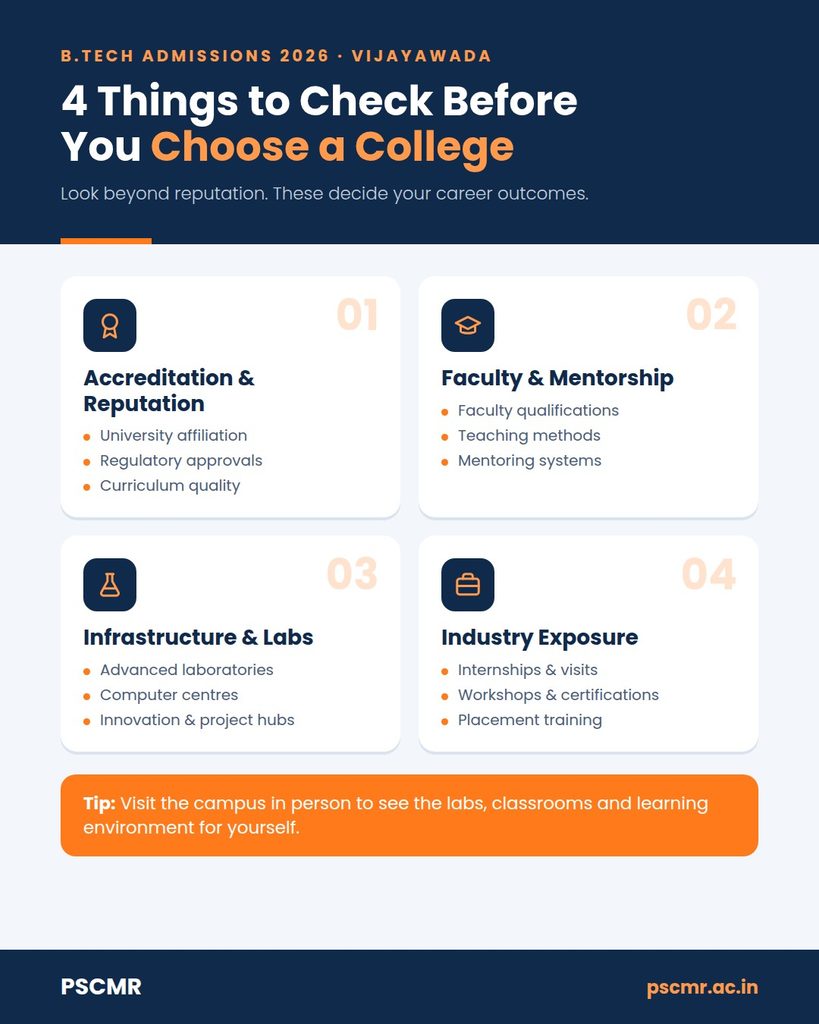
Selecting the right engineering college requires careful evaluation of academic quality, faculty expertise, infrastructure, industry exposure, and career outcomes. A well-informed decision can help students maximize learning opportunities and improve future career prospects.
Many students choose colleges based on reputation alone, but successful college selection involves looking deeper into the factors that influence educational quality and employability. Institutions that emphasize practical learning, innovation, and professional development often provide stronger long-term value.
Academic Reputation and Accreditation
A strong academic foundation begins with choosing an institution that follows recognized educational standards. Students should verify university affiliations, regulatory approvals, curriculum quality, and academic achievements before applying.
An institution’s academic reputation reflects its commitment to delivering quality education, maintaining curriculum standards, and supporting student success. This becomes especially important when students plan for higher studies, competitive examinations, or professional careers after graduation.
Faculty Expertise and Student Mentorship
Faculty members significantly influence the learning experience throughout engineering education. Experienced educators help students understand complex concepts, develop analytical thinking, and apply theoretical knowledge to practical situations.
Students searching for the best B.Tech college in Vijayawada should evaluate faculty qualifications, teaching methodologies, mentoring systems, and opportunities for academic guidance. Effective mentorship can enhance both academic performance and professional development.
Modern Infrastructure and Learning Facilities
Engineering education relies heavily on practical learning experiences. Advanced laboratories, computer centers, innovation hubs, and project development facilities enable students to gain hands-on exposure to engineering technologies.
Well-equipped campuses support experimentation, research, collaborative learning, and technical skill development. Access to modern infrastructure helps students strengthen their understanding of engineering concepts and improve their readiness for industry challenges.
Industry Exposure and Skill Development
Employers increasingly seek graduates who possess practical skills alongside academic knowledge. Engineering colleges that provide internships, industrial visits, workshops, certification programs, and industry interactions help students bridge the gap between classroom learning and workplace expectations.
Programs focused on career readiness often improve employability and help students build confidence before entering competitive job markets.
PSCMR Faculty Insight
“Engineering education becomes more effective when students combine classroom learning with practical application, industry interaction, innovation, and continuous skill development.”
Why Is Choosing the Right Engineering Branch Equally Important?
Selecting the right engineering specialization is just as important as selecting the right college. Students should align their interests, strengths, career aspirations, and industry trends when making this decision.
Today’s engineering landscape offers diverse opportunities across technology, manufacturing, infrastructure, automation, and emerging digital sectors. Choosing a branch based solely on popularity may not always lead to long-term satisfaction or career growth.
Computer Science and Emerging Technologies
Students interested in software development, programming, cloud computing, and digital innovation often consider btech computer science and engineering in vijayawada as a preferred option. The growing demand for technology professionals continues to create opportunities across multiple industries.
Specializations related to software engineering, cybersecurity, data analytics, and application development remain highly relevant in today’s digital economy.
Artificial Intelligence and Data-Driven Careers
The rise of automation and intelligent systems has increased demand for professionals skilled in AI and analytics. Students exploring an AI course in Vijayawada or pursuing Artificial Intelligence Engineering in Vijayawada gain exposure to technologies that are transforming industries worldwide.
Similarly, students interested in data interpretation, predictive analytics, and business intelligence may find a Data science course in Vijayawada aligned with future career opportunities.
Core Engineering Disciplines
Branches such as Electronics, Mechanical, Civil, and Electrical Engineering continue to offer strong career prospects across diverse industries. Students should evaluate personal interests, industry demand, and long-term goals before finalizing a specialization.
The most suitable branch is often the one that aligns with both individual strengths and future aspirations rather than short-term trends.
What Does the B.Tech Admission Process 2026 Typically Involve?
Understanding the admission process helps students and parents prepare documentation, evaluate options, and avoid last-minute confusion. While admission procedures may vary slightly between institutions, most engineering colleges follow a structured process that focuses on eligibility, counseling, course selection, and enrollment.
Students should begin researching colleges well before application deadlines. Early planning allows them to compare programs, review infrastructure, understand placement support, and identify institutions that align with their academic and career goals.
Understanding Eligibility Requirements
Before applying, students should verify the Engineering Admission Eligibility Criteria established by the institution and relevant authorities. Eligibility generally depends on successful completion of Intermediate education with Mathematics, Physics, and Chemistry or equivalent qualifying subjects.
Students should also monitor admission notifications, counseling schedules, application deadlines, and required documentation to ensure a smooth admission experience.
Evaluating Available B.Tech Programs
One of the most important stages of the admission process involves selecting the right specialization. Students should compare various btech courses in Vijayawada based on industry demand, future career opportunities, curriculum relevance, and personal interests.
Instead of choosing a branch solely because it is popular, students should consider their aptitude, long-term goals, and emerging industry trends.
Reviewing Campus Facilities and Student Support
Admissions should not be based solely on course availability. Students should also evaluate academic facilities, laboratories, libraries, innovation centers, placement training, and student development programs.
Colleges that invest in comprehensive learning ecosystems often provide students with greater opportunities for academic growth, practical learning, and career readiness.
PSCMR Placement Insight
“Students who actively participate in internships, technical projects, and industry training programs often demonstrate stronger employability and career readiness.”
Why Are Industry Exposure and Practical Learning Important for Engineering Students?
Engineering education has evolved significantly over the last decade. Employers increasingly expect graduates to possess practical skills, technical competence, problem-solving abilities, and workplace readiness in addition to academic knowledge.
Industry exposure helps students understand how engineering concepts are applied in real-world environments. It bridges the gap between classroom learning and professional expectations.
Internships and Real-World Experience
Internships provide valuable opportunities for students to work on live projects, interact with professionals, and gain exposure to industry practices. Students who participate in internships often develop stronger technical capabilities and workplace confidence.
Many organizations prefer graduates who already possess practical experience because they adapt more quickly to professional environments.
Industry Collaboration Opportunities
Engineering institutions that maintain industry partnerships often create opportunities for workshops, guest lectures, certification programs, and collaborative projects. These experiences expose students to emerging technologies, professional standards, and evolving industry expectations.
Regular interaction with industry experts helps students understand current market demands and future employment trends.
Project-Based Learning
Project-based learning encourages students to apply theoretical knowledge to practical challenges. Through technical projects, students develop creativity, teamwork, communication skills, and engineering problem-solving abilities.
These experiences strengthen portfolios and often improve placement opportunities after graduation.
What Recent Engineering Education Trends Suggest About Future Career Opportunities?
The engineering sector continues to evolve as industries adopt automation, artificial intelligence, digital transformation, advanced manufacturing, and data-driven decision-making. Students entering engineering programs today will likely work in environments that demand continuous learning and technological adaptability.
Understanding industry trends helps students select courses and institutions that support long-term career growth.
Engineering Employment Continues to Expand
Many industries continue investing in digital technologies, infrastructure development, automation systems, software solutions, and smart technologies. As a result, demand for skilled engineering professionals remains strong across multiple sectors.
Graduates with both technical expertise and practical skills often have access to a wider range of career opportunities.
Emerging Technology Roles Are Growing
Fields related to Artificial Intelligence, Data Science, Machine Learning, Cloud Computing, and Cybersecurity continue to attract significant attention from employers.
Students pursuing studies connected to AI and DS admission in Vijayawada or emerging technology programs often gain exposure to rapidly expanding career pathways that support innovation across industries.
Employers Value Skills Alongside Academic Performance
Academic success remains important, but organizations increasingly evaluate candidates based on communication abilities, technical competencies, teamwork, adaptability, and project experience.
Students who participate in internships, technical competitions, certifications, and innovation initiatives frequently strengthen their employability profiles.
B.Tech Admission Planning: Traditional Approach vs Smart Student Approach
| Traditional Admission Approach | Smart Student Approach |
| Select the first available college | Research multiple colleges thoroughly |
| Focus only on admission availability | Evaluate academic quality and outcomes |
| Choose a branch based on popularity | Match specialization with career goals |
| Compare colleges only by fees | Assess value, facilities, and opportunities |
| Look only at infrastructure photos | Review laboratories, faculty, and training support |
| Focus only on degree completion | Focus on employability and career readiness |
| Ignore internship opportunities | Prioritize industry exposure and practical learning |
| Evaluate placements at the last stage | Consider placement support from the beginning |
What Recent Engineering Education Research Suggests
- Demand for technology-focused professionals continues to increase across software, analytics, automation, and engineering sectors.
- Students who complete internships and project-based learning activities often demonstrate stronger workplace readiness.
- Employers increasingly seek graduates who possess both technical expertise and communication skills.
- Emerging technologies such as Artificial Intelligence, Machine Learning, Data Analytics, and Cloud Computing continue creating new career opportunities.
- Industry certifications and practical training programs can strengthen employability alongside academic qualifications.
- Engineering graduates with exposure to innovation and research activities often demonstrate stronger problem-solving capabilities.
PSCMR Academic Insight
“A future-focused engineering curriculum should help students develop problem-solving abilities, adaptability, communication skills, and technical expertise.”
Why Should Students Consider Career Development and Placement Support Before Taking Admission?
A quality engineering education should prepare students not only for examinations but also for successful careers after graduation. While academic learning forms the foundation, placement preparation, skill development, internships, and career guidance play a major role in shaping future opportunities.
Students evaluating a Private Engineering College in Vijayawada should understand how the institution supports employability through training programs, industry interactions, mock interviews, aptitude development, and professional skill enhancement initiatives.
Placement Readiness Begins Early
Career preparation should start from the first year rather than waiting until the final semester. Students who consistently build technical knowledge, communication skills, and practical experience are often better prepared for campus recruitment opportunities.
Engineering institutions that offer structured placement training help students improve aptitude, problem-solving abilities, interview performance, and workplace readiness.
Technical Skills and Certifications
Industries increasingly value practical competencies alongside academic qualifications. Certification programs, workshops, coding platforms, and technical training sessions help students strengthen their profiles and remain competitive in the job market.
Continuous learning allows students to adapt to changing technologies and industry expectations throughout their academic journey.
Building Professional Confidence
Career success depends on more than technical knowledge. Communication skills, leadership qualities, teamwork, and adaptability are equally important for professional growth.
Colleges that encourage presentations, projects, innovation activities, and collaborative learning often help students develop confidence that supports both placement success and long-term career advancement.
How Can Students and Parents Evaluate a College Beyond Rankings and Advertisements?
College rankings and promotional materials provide only a limited picture of the student experience. A more effective approach involves evaluating factors that directly influence learning outcomes, skill development, and career readiness.
Students should focus on academic quality, faculty support, practical learning opportunities, student achievements, placement initiatives, and institutional culture before making a final decision.
Visit the Campus and Explore Facilities
A campus visit provides valuable insight into the learning environment. Students can observe laboratories, classrooms, libraries, innovation centers, and other facilities that contribute to academic development.
Experiencing the campus firsthand often helps students determine whether the institution aligns with their learning preferences and career goals.
Understand Student Development Opportunities
Engineering education extends beyond classroom instruction. Students benefit from participation in technical clubs, innovation activities, workshops, competitions, leadership programs, and professional development initiatives.
Institutions that encourage holistic development often help students build a broader range of skills that contribute to future success.
Review Academic and Career Support Systems
Students should also evaluate mentoring programs, academic counseling, placement guidance, internship support, and career planning resources.
Strong support systems create an environment where students can overcome challenges, maximize opportunities, and progress confidently toward their goals.
Why Is PSCMR a Strong Choice for Students Exploring B.Tech Admissions 2026 Vijayawada?
Students seeking engineering education today need more than a traditional academic experience. They require opportunities to develop technical expertise, practical skills, industry awareness, and professional confidence that support long-term success.
At PSCMR College of Engineering & Technology, the emphasis extends beyond classroom learning to include innovation, skill development, project-based learning, career readiness, and continuous student growth.
Industry-Oriented Learning Environment
Engineering education becomes more meaningful when students can connect theory with practical application. Through modern learning approaches, laboratory experiences, technical activities, and industry-focused exposure, students gain a deeper understanding of engineering concepts.
This approach supports stronger academic performance while improving workplace readiness.
Focus on Emerging Technologies
As industries continue embracing digital transformation, students increasingly seek opportunities in future-focused fields such as Artificial Intelligence, Data Science, and advanced computing technologies.
Programs related to Artificial Intelligence Engineering in Vijayawada and emerging technology domains provide students with exposure to innovations that are reshaping industries worldwide.
Student Growth Beyond Academics
Engineering success requires a combination of technical knowledge, communication abilities, leadership qualities, adaptability, and professional ethics.
PSCMR encourages students to participate in activities that support overall development, helping them become confident professionals prepared for both higher education and career opportunities.
Final Thoughts on B.Tech Admissions 2026 Vijayawada
Choosing an engineering college is a decision that can influence a student’s future academic journey, career opportunities, and professional growth. While admissions are an important first step, long-term success often depends on selecting an institution that provides quality education, practical learning experiences, industry exposure, and strong student support systems.
As students explore B.Tech Admissions 2026 Vijayawada, they should focus on factors such as academic excellence, faculty expertise, infrastructure, placement support, emerging technology opportunities, and overall career readiness. Institutions that combine these elements create an environment where students can develop technical competence, professional confidence, and future-ready skills.
At PSCMR College of Engineering & Technology, students benefit from a learning ecosystem designed to support innovation, academic achievement, skill development, and career growth. By making informed admission decisions today, students can build a stronger foundation for tomorrow’s opportunities.
Frequently Asked Questions
How can I apply for B.Tech Admissions 2026 Vijayawada?
Students can begin by reviewing admission notifications, eligibility criteria, available specializations, and required documentation. Early planning helps simplify the application and enrollment process.
What should students consider before choosing an engineering college?
Students should evaluate academic quality, faculty expertise, infrastructure, placement support, industry exposure, internship opportunities, and career development initiatives.
What are the eligibility requirements for B.Tech admission?
Eligibility generally requires successful completion of Intermediate education with Mathematics, Physics, and Chemistry or equivalent qualifying subjects as specified by the institution and regulatory authorities.
Why is industry exposure important during engineering education?
Industry exposure helps students understand real-world applications of engineering concepts, develop practical skills, and improve career readiness through internships, projects, and professional interactions.
How important are placements when selecting an engineering college?
Placements reflect how effectively an institution prepares students for professional careers. Strong placement support can help students transition successfully from academics to employment.
Which engineering specialization offers strong future opportunities?
Career opportunities exist across multiple branches , including Computer Science, Artificial Intelligence, Data Science, Electronics, Mechanical, Civil, and Electrical Engineering. Students should choose a specialization based on interests, strengths, and career goals.
What makes PSCMR different from other engineering colleges?
PSCMR emphasizes academic excellence, practical learning, industry-oriented education, skill development, innovation, and career readiness to support student success beyond graduation.
Why should students start admission planning early?
Early planning allows students to compare colleges, explore specializations, understand admission requirements, and make informed decisions without unnecessary pressure during the admission season.