
Choosing the Right Engineering College Is About More Than Just Admission
Finding the right engineering college is one of the most important decisions for students after Intermediate. For many families, the challenge is not just getting admission but choosing a college that offers strong academics, career-focused learning, practical exposure, and good placement opportunities. When students start exploring Engineering College Admissions Vijayawada, they need clear information about specializations, faculty quality, campus facilities, and the kind of career support a college can provide in the long run.
Introduction
Students and parents looking at engineering admissions often have several questions at the same time. Which branch has better career scope? Is it better to choose a college based on placements, infrastructure, or reputation? How important are internships and industry exposure? These questions become even more relevant when students are comparing options such as Computer Science, Artificial Intelligence, Data Science, Electronics, Civil, or Mechanical Engineering. The decision is not only about joining an engineering program, but also about choosing a learning environment that can support future career growth.
When evaluating Engineering College Admissions Vijayawada, students should look beyond admission brochures and basic course lists. The right college should offer academic quality, practical learning, placement support, faculty mentorship, and opportunities to build industry-relevant skills. At PSCMR College of Engineering & Technology, the emphasis is on helping students build strong technical foundations, improve employability, and gain the exposure needed to succeed in a competitive engineering landscape.
What Should Students and Parents Look for During Engineering College Admissions in Vijayawada?
Students and parents should evaluate more than just admission availability or branch options when comparing engineering colleges. A strong engineering institution should provide a combination of academic excellence, placement support, practical learning, modern infrastructure, and opportunities for long-term student development.
For students exploring B.Tech Admissions Vijayawada, it is important to check whether the college supports both classroom learning and career preparation. Colleges that focus on internships, project work, communication skills, technical training, and industry interaction often provide a stronger overall learning experience. This is especially important for students who want to build a future in competitive technology and engineering fields.
How Can Students Identify an Engineering College with Strong Placement Support?
Placement support is one of the biggest factors students and parents consider while selecting an engineering college. A good placement ecosystem shows that the institution is not only delivering academic instruction but also helping students prepare for real career opportunities. Placement readiness depends on many elements, including technical training, aptitude preparation, soft skill development, internships, and the college’s ability to connect students with recruiters.
Students searching for an engineering college with placements in Vijayawada should first understand that placements are not built in the final year alone. The best colleges begin career development much earlier by training students in communication, problem solving, coding, interview preparation, teamwork, and industry expectations. A placement-focused environment helps students become confident, job-ready, and better prepared for campus recruitment opportunities.
Placement Training Beyond the Classroom
Strong placement support often starts with structured training programs that help students improve aptitude, reasoning, communication, and interview performance. These skills matter because companies increasingly look for graduates who can combine technical knowledge with professional readiness.
A college that provides regular placement workshops, mock interviews, resume guidance, and technical assessments gives students a practical advantage. This kind of preparation becomes especially valuable for students who want to enter competitive industries after graduation.
Role of Internships in Career Preparation
Internships are one of the most important bridges between academics and employment. Students who complete internships often gain exposure to real work environments, team collaboration, deadlines, tools, and professional expectations. They also develop confidence by applying theoretical concepts to real tasks.
When students compare colleges, they should ask how the institution supports internships, live projects, and industry collaborations. An engineering college that encourages internships often contributes more effectively to student employability.
Campus Recruitment and Career Readiness
Placement support should not be judged only by company names or final-year recruitment drives. Students should also look at how consistently the college builds readiness through technical training, coding support, career counseling, communication development, and industry interaction.
A college with a strong placement culture usually creates an ecosystem where students are continuously guided toward career readiness rather than being left to prepare at the last moment.
PSCMR Faculty Insight
“Engineering education becomes more effective when students combine classroom learning with practical application, industry interaction, innovation, and continuous skill development.”
Why Does Industry Exposure Matter So Much in Engineering Education?
Engineering is a practical discipline, and students learn best when classroom concepts are connected to real-world applications. Industry exposure helps students understand how engineering knowledge is used in professional environments, what employers expect, and how technology is evolving across sectors. It gives students a more complete understanding of their field and prepares them for workplace challenges beyond textbooks and examinations.
When parents and students compare colleges, they often focus on infrastructure or course names but overlook how important industry engagement can be. A college with strong industry exposure offers students opportunities to participate in internships, industrial visits, workshops, guest lectures, certification programs, and practical projects. This kind of learning can significantly improve student confidence and employability.
Learning Through Real-World Application
Students benefit when they see how engineering principles are used in software, manufacturing, electronics, infrastructure, automation, and data-driven industries. Real-world exposure makes learning more relevant and helps students understand why certain concepts matter in practice.
For students interested in future-focused domains like Artificial Intelligence Engineering in Vijayawada or a Data science course in Vijayawada, industry exposure becomes even more important because these fields evolve rapidly and require constant learning beyond the syllabus.
Building Professional Awareness Early
Industry interaction helps students understand workplace expectations long before graduation. It introduces them to professional communication, teamwork, deadlines, problem solving, and the tools or technologies commonly used in their chosen field.
This early awareness often helps students make better decisions about certifications, internships, projects, and career paths. It also improves confidence during interviews and placement processes.
Strengthening Employability Through Practical Learning
Students who participate in practical learning environments often develop stronger technical understanding than those who rely only on classroom instruction. Workshops, labs, projects, and industrial exposure help students build skills that employers value.
This is why students should give importance to colleges that promote practical learning, especially when comparing options for engineering admissions.
What Academic and Infrastructure Factors Should Students Evaluate Before Taking Admission?
A strong engineering college must provide more than just classrooms and course lists. Students need access to qualified faculty, modern laboratories, libraries, computing resources, innovation spaces, and a campus environment that supports both academics and skill development. Academic quality and infrastructure directly influence how effectively students can learn, experiment, and grow during their engineering journey.
Students searching for the best B.Tech college in Vijayawada should evaluate whether the college has updated laboratories, experienced faculty, project support, mentoring systems, and resources that align with present-day industry needs. The right infrastructure creates opportunities for better practical learning, deeper technical understanding, and stronger preparation for future careers.
Faculty Mentorship and Teaching Quality
Faculty members play a major role in shaping student outcomes. Beyond teaching, they guide students in projects, technical problem solving, internships, academic performance, and career planning. Strong faculty mentorship can make a significant difference in how students learn and perform.
A college with committed faculty and a supportive academic environment helps students build both technical clarity and confidence throughout their course.
Laboratories and Technical Learning Resources
Engineering students need practical exposure through laboratories, workshops, software tools, and project facilities. These resources help them understand the real application of engineering concepts rather than treating the subject as theory alone.
Well-equipped labs and modern learning resources are especially important for students considering advanced technology areas such as AI, Data Science, Computer Science, and Electronics.
Learning Environment and Student Growth
A college’s environment also matters. Students perform better when they have access to technical clubs, project opportunities, innovation activities, seminars, and peer learning experiences that encourage active participation.
A strong learning environment supports both academic achievement and personal growth, which is why it should be part of every admission decision.
Discover engineering specializations, academic facilities, placement support, and practical learning opportunities designed to help students build a strong foundation for future success.
What Does the Engineering Admission Process in Vijayawada Usually Involve?
For many students and parents, the admission process itself can feel confusing because it involves more than simply submitting an application. Engineering admissions require students to understand eligibility criteria, available programs, counseling timelines, documentation, and the long-term value of the college they are choosing. A structured approach can make the process easier and help students avoid rushed decisions.
When students begin exploring Engineering College Admissions Vijayawada, they should start by shortlisting colleges based on academics, placements, infrastructure, and branch availability. Admission planning works best when students compare colleges early, understand the required documents, track important dates, and evaluate whether the institution matches their career goals rather than choosing based only on convenience.
Understanding Eligibility and Admission Requirements
Before applying, students should carefully review the eligibility criteria for the college and the engineering program they want to join. In most cases, admission requires successful completion of Intermediate with Mathematics, Physics, and Chemistry or an equivalent academic background, along with any entrance or counseling requirements that may apply.
Students should also verify whether the college is AICTE approved, university affiliated, and recognized for offering quality engineering education. These details matter because they affect academic credibility, learning standards, and the long-term value of the degree.
Choosing the Right Engineering Specialization
Selecting a branch is one of the most important parts of the admission process because it shapes a student’s learning experience and future career opportunities. Students should compare branches based on interest, aptitude, industry demand, and the type of work they see themselves doing in the future.
For some students, btech computer science and engineering in vijayawada may feel like the right choice because of the wide scope in software, programming, and technology-driven careers. Others may be more interested in Electronics, Civil, Mechanical, or Electrical Engineering based on their strengths and long-term aspirations.
Comparing Colleges Before Finalizing Admission
Admission decisions should not be based only on seat availability or a single brochure. Students should compare faculty quality, campus facilities, laboratories, placement training, industry exposure, internships, and student support systems before making a final choice.
This comparison helps students understand which college offers not only admission but also a better learning environment and stronger future opportunities.
How Should Students Choose the Right Engineering Branch for Long-Term Career Growth?
Choosing the right branch is one of the most important decisions students make during the admission process because the branch often influences academic interest, skill development, and future career direction. While students naturally look at job trends and popular specializations, the best decision usually comes from balancing personal interest with long-term career potential.
Students should not select a branch simply because it is trending or because friends are choosing it. Instead, they should consider what subjects they enjoy, what kind of problems they like solving, and which career paths match their strengths. The right branch creates more motivation to learn, perform well, and build a strong professional foundation.
Computer Science and Technology-Driven Careers
Computer Science remains one of the most preferred engineering options because of its relevance across software, digital products, cloud technologies, and emerging tech industries. Students who enjoy programming, logic, systems, and application development often find Computer Science aligned with their career goals.
This is one reason many students exploring btech courses in Vijayawada compare colleges based on the quality of their Computer Science department, placement support, coding ecosystem, and exposure to new technologies.
Artificial Intelligence and Data-Focused Programs
Students interested in automation, intelligent systems, analytics, and future-facing technologies often look at programs related to AI and Data Science. The demand for these fields continues to grow across industries such as finance, healthcare, retail, manufacturing, and software.
For students comparing future-ready options, AI and DS admission in Vijayawada or programs linked to advanced computing can offer strong long-term potential, provided the college supports practical learning and industry relevance.
Core Engineering Disciplines Still Offer Strong Opportunities
Core branches such as Electronics, Electrical, Mechanical, and Civil Engineering continue to play an important role across infrastructure, manufacturing, energy, transportation, and technology systems. These branches remain relevant for students who are interested in applied engineering, design, operations, and technical problem solving.
The best branch is not necessarily the most popular one. It is the branch that matches the student’s interest, learning style, and long-term career goals while also being supported by a strong academic environment.
What Makes a Placement-Oriented Engineering College More Valuable for Students?
A placement-oriented engineering college creates value by helping students transition from academic learning to professional careers with greater confidence. It supports students not only through coursework but also through training, mentorship, industry exposure, technical skill development, and employability preparation. This kind of environment can make a meaningful difference in how prepared students feel by the time they graduate.
When families compare engineering colleges, they often focus on whether placements happen, but the more useful question is how the college prepares students for those placements. Colleges that build placement readiness from the early years usually offer better long-term outcomes than colleges that focus only on final-year recruitment.
Training for Employability, Not Just Examinations
Students need more than good marks to succeed in the hiring process. They also need aptitude, communication, technical depth, interview confidence, teamwork, and the ability to solve real-world problems. Placement-oriented colleges recognize this and build employability training into the student journey.
This may include coding practice, mock interviews, group discussions, technical workshops, soft skill development, and career guidance that supports students consistently over time.
Industry-Focused Learning Improves Career Outcomes
A college that encourages internships, industry interaction, practical projects, and live problem solving helps students build stronger professional awareness. These experiences improve not just resumes but also confidence, adaptability, and workplace understanding.
Students who gain this kind of exposure are often better prepared for campus placements, higher studies, and future professional growth.
Support Systems That Help Students Grow
Placement success also depends on the support students receive from mentors, faculty, training teams, and the institution’s career ecosystem. A college that provides structured support can help students identify weaknesses, improve steadily, and prepare for different kinds of opportunities.
This is one reason why placement support should be seen as part of the overall learning experience rather than as a final-year add-on.
PSCMR Placement Insight
“Students who actively participate in internships, technical projects, industry training, and skill development programs often build stronger employability and greater confidence for future career opportunities.”
How Does PSCMR Support Students Looking for Career-Focused Engineering Education?
Students today need engineering education that prepares them not only for examinations but also for careers in a fast-changing professional world. This means the right college should offer academic strength, practical learning, industry exposure, skill development, and placement preparation in a balanced way. Students and parents looking for a career-focused engineering college should evaluate how the institution supports both learning and long-term professional growth.
At PSCMR College of Engineering & Technology, the emphasis is on creating a learning environment where students can strengthen technical knowledge, participate in practical learning, develop industry-relevant skills, and prepare for future opportunities. This approach supports students who want to build strong foundations in engineering while staying ready for changing industry demands.
Academic Learning with Practical Relevance
PSCMR encourages students to move beyond textbook learning by connecting academic concepts with practical application. Through laboratories, technical activities, project work, and industry-oriented exposure, students gain a more meaningful understanding of engineering concepts.
This helps students not only perform academically but also develop the confidence needed to solve real engineering problems.
Student Development Beyond the Syllabus
Engineering success depends on more than subject knowledge. Students also need communication skills, problem-solving ability, teamwork, professional confidence, and the discipline to keep learning as technology evolves.
A college that supports holistic student development creates stronger long-term outcomes because it prepares students for both placements and future professional responsibilities.
Career Readiness as a Continuous Process
Career preparation works best when it begins early and continues throughout the engineering journey. Colleges that focus on training, mentorship, technical skill building, and practical exposure can help students grow steadily rather than leaving career preparation to the final year.
This makes the college experience more valuable because students graduate with stronger academic and professional readiness.
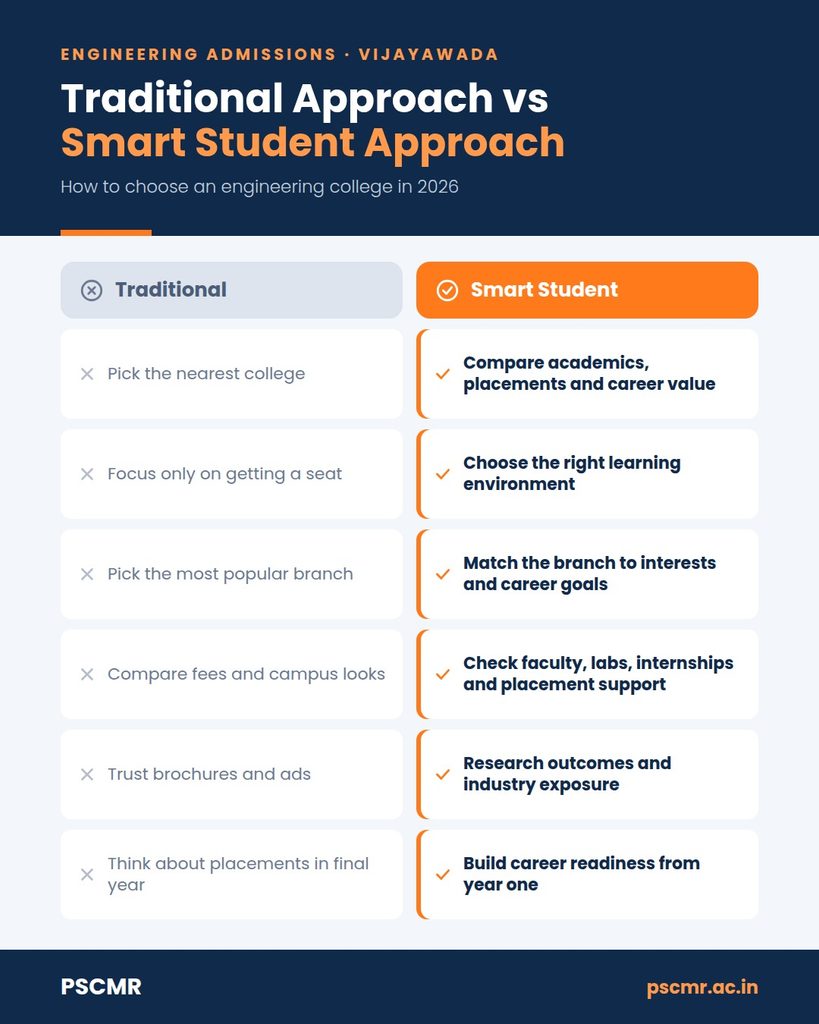
Engineering Admission Decisions: Traditional Approach vs Smart Student Approach
| Traditional Admission Approach | Smart Student Approach |
| Choose a college based only on nearby location | Compare colleges based on academics, placements, and long-term career value |
| Focus only on getting a seat | Focus on choosing the right learning environment |
| Select a branch based on popularity | Match branch selection with interests and future career goals |
| Compare only fees and campus appearance | Evaluate faculty, labs, internships, and placement support |
| Look only at brochures and advertisements | Research academic quality, student outcomes, and industry exposure |
| Wait until final year to think about placements | Choose a college that builds career readiness from the beginning |
What Do Current Engineering Education Trends Tell Us About Student Careers?
Engineering careers are changing quickly because industries are investing in automation, data-driven systems, digital transformation, smart technologies, and advanced computing. As a result, students entering engineering programs today need more than subject knowledge. They need practical skills, adaptability, and the ability to keep learning as industries evolve.
Recent trends show growing demand for graduates who can combine technical understanding with real-world application. Employers increasingly value project experience, internships, communication skills, problem-solving ability, and exposure to emerging technologies. This is why colleges that support practical learning and industry engagement often create stronger career outcomes for students.
What Recent Engineering Education Research Suggests
- Students with internship and project experience often demonstrate stronger employability and workplace readiness.
- Employers increasingly prioritize practical problem solving, communication, and adaptability alongside academic performance.
- Fields such as Artificial Intelligence, Data Science, Cybersecurity, Cloud Computing, and Automation continue to expand career opportunities.
- Engineering graduates who receive placement training and industry exposure often feel more confident during recruitment processes.
- Colleges that combine technical learning with skill development are better positioned to prepare students for future career demands.
Learn more about engineering specializations, practical learning opportunities, student development support, and career-focused education designed to help you make a confident admission decision.
Why Should Students and Parents Look Beyond Rankings Before Finalizing Engineering Admission?
College rankings, advertisements, and word-of-mouth recommendations can be useful starting points, but they should not be the only basis for an admission decision. A college may appear attractive because of visibility or popularity, yet the real student experience depends on academic quality, practical learning opportunities, faculty support, career guidance, and the institution’s ability to prepare students for life after graduation. For students planning their future, these deeper factors matter much more than surface-level comparisons.
When evaluating Engineering College Admissions Vijayawada, students and parents should focus on the complete educational ecosystem. This includes the quality of the faculty, access to modern laboratories, opportunities for internships and projects, the placement training process, and the overall learning environment. Colleges that invest in student growth across academics, skills, and industry readiness usually provide stronger long-term value than institutions that focus only on marketing or short-term impressions.
Evaluating the Learning Environment
A strong learning environment encourages curiosity, experimentation, collaboration, and consistent improvement. Students benefit when they have access to laboratories, technical clubs, project support, seminars, innovation activities, and a campus culture that values practical learning. These experiences often shape confidence and competence as much as classroom teaching.
Parents can also look at how the college supports students academically outside lectures. Mentoring systems, faculty accessibility, doubt clarification, and structured guidance often make a major difference in student outcomes over four years.
Looking at Career Development as Part of Education
Engineering education should not end with subject completion. It should help students move steadily toward career readiness through internships, communication training, technical development, and professional awareness. Students should therefore assess whether the college sees placements and career growth as part of the learning process rather than as a final-year formality.
A college that supports students in building both technical and professional strengths can create better outcomes in terms of confidence, employability, and future opportunities.
How Can Students Make a Smarter Engineering Admission Decision in 2026?
Making a smart admission decision begins with asking the right questions. Instead of choosing a college based only on branch popularity or convenience, students should compare how each institution supports learning, practical exposure, and career development over the full duration of the program. A thoughtful decision today can reduce confusion later and help students stay motivated, engaged, and future-ready.
Students should begin by shortlisting colleges based on recognized academic standards, available branches, faculty quality, laboratory facilities, placement support, and industry exposure. It is also useful to think about the kind of learner the student is, what subjects genuinely interest them, and what career path they may want to build over time. A strong admission decision balances opportunity, personal fit, and long-term growth.
Ask the Right Questions Before Applying
Students and parents should ask questions such as: What practical learning opportunities does the college provide? How early does placement training begin? Are there internships, technical workshops, or industry visits? What kind of mentoring and academic support is available? How does the college help students build both technical and communication skills?
These questions help move the conversation from “Can I get admission here?” to “Will this college actually help me grow and succeed?” That shift often leads to better decisions.
Compare Value, Not Just Visibility
A well-known name or a visually attractive campus does not always guarantee the best learning experience. Students should compare colleges based on what they truly offer in terms of academic depth, faculty guidance, practical exposure, and student development opportunities.
The best choice is often the college that aligns academic quality with real support for skill development, industry readiness, and future career planning.
Why Is PSCMR a Strong Choice for Students Looking for Engineering College Admissions in Vijayawada?
Students looking for an engineering college today need an institution that supports them academically while also preparing them for future professional demands. That means the college should offer not only quality teaching but also practical learning, technical development, industry awareness, and placement preparation. A future-focused engineering education must help students become capable professionals, not just degree holders.
At PSCMR College of Engineering & Technology, the focus is on building this broader learning journey. Students are encouraged to strengthen subject knowledge, work with modern laboratories, participate in technical learning activities, and build the professional skills needed for competitive careers. This approach makes PSCMR relevant for students who want both academic structure and career-oriented engineering education.
A Career-Focused Learning Ecosystem
PSCMR supports students through an environment that values academic excellence, practical exposure, and continuous skill development. This creates a learning ecosystem where students can strengthen their fundamentals while also preparing for internships, projects, placement opportunities, and future professional challenges.
For students comparing colleges during Engineering College Admissions Vijayawada, this balance between academic learning and career readiness can make a meaningful difference in long-term outcomes.
Exposure to Emerging Technology Pathways
Engineering careers are increasingly shaped by fields such as Artificial Intelligence, Data Science, software development, automation, and advanced electronics. Students need institutions that understand these changes and create opportunities to engage with modern technologies and evolving industry needs.
This is especially valuable for students exploring areas such as AI course in Vijayawada, AI and ML courses in vijayawada, or advanced computing pathways linked to future-focused engineering careers.
Student Growth Beyond the Degree
Engineering success depends not only on technical knowledge but also on communication, confidence, discipline, adaptability, and the ability to learn continuously. PSCMR’s student-focused environment supports growth in these areas by encouraging learning beyond the syllabus and helping students prepare for the expectations of the professional world.
That combination of academics, practical learning, and student development makes engineering education more meaningful and future-ready.
PSCMR Academic Insight
“A future-focused engineering education should help students build technical depth, professional confidence, problem-solving ability, and the adaptability required to grow in a rapidly changing industry environment.”
Final Thoughts on Engineering College Admissions Vijayawada
Choosing an engineering college is one of the most important decisions students make after Intermediate because it influences academic growth, technical development, confidence, and career direction for years to come. While admission itself is the starting point, the real value lies in selecting a college that offers strong academics, practical learning, industry exposure, and placement support in a balanced way. Students should therefore look beyond basic admission availability and focus on the complete learning ecosystem the college provides.
For students and parents comparing Engineering College Admissions Vijayawada, the goal should be to find an institution that supports both present learning needs and future career ambitions. Academic quality, faculty mentorship, laboratories, internships, placement training, and emerging technology exposure all contribute to a more meaningful engineering education. At PSCMR College of Engineering & Technology, students benefit from a career-focused environment designed to strengthen technical knowledge, improve employability, and support long-term professional growth. A thoughtful admission decision today can become the foundation for a stronger engineering future tomorrow.
Frequently Asked Questions
How do I apply for Engineering College Admissions in Vijayawada?
Students should begin by checking the college’s admission notifications, eligibility criteria, available engineering branches, and required documents. It is helpful to shortlist colleges early and compare academics, placements, and infrastructure before applying.
What should students consider before choosing an engineering college?
Students should look at academic quality, faculty experience, placement support, laboratory facilities, internships, industry exposure, and the overall learning environment. A good college should support both technical learning and long-term career development.
Why is placement support important during engineering admissions?
Placement support shows how seriously a college prepares students for employment after graduation. Colleges that offer training, internships, mock interviews, aptitude development, and career guidance often help students become more confident and job-ready.
How important is industry exposure in engineering education?
Industry exposure helps students understand how engineering concepts are applied in real work environments. It improves practical learning, professional awareness, and employability through internships, workshops, projects, and industry interaction.
What documents are usually required for engineering admission?
Documents typically include academic mark sheets, identity proof, transfer or study certificates, passport-size photographs, and any documents required for counseling or category verification. Students should always confirm the exact list with the college before applying.
How can I choose the right engineering branch?
Students should choose a branch by considering their interests, aptitude, long-term career goals, and the scope of the specialization. It is better to select a branch that genuinely fits the student’s strengths rather than following trends alone.
Is Computer Science the best option for engineering students?
Computer Science is a strong option for students interested in software, coding, and technology careers, but it is not the only valuable branch. The best branch depends on the student’s interest, skills, and the kind of career they want to build.
Why should parents look beyond rankings while selecting a college?
Rankings and advertisements do not always reflect the full student experience. Parents should also evaluate faculty quality, practical learning, placement support, student development, and how well the college prepares students for future careers.
What makes PSCMR a good option for engineering admissions?
PSCMR offers a learning environment focused on academic quality, practical exposure, student development, and career readiness. The college aims to support students through strong technical learning, industry-oriented education, and placement-focused growth.
When should students start planning for engineering admissions?
Students should ideally begin planning as early as possible after Intermediate so they have enough time to compare colleges, understand eligibility, review specializations, and make an informed decision without last-minute pressure.